To work together to responsibly grow our community and to provide quality, cost-effective and efficient government services.
Strategic Plan
Each year, the Ramsey City Council meets with staff to review and update the Strategic Action Plan, which guides and focuses the City’s work for both the present and the future. The purpose of this plan is to create an open and transparent working environment and to establish shared expectations between elected officials and City staff. Ramsey’s Strategic Action Plan is a dynamic document that is regularly revisited to address the needs of our growing community.
The strategic plan includes a mission statement, which is to be achieved through specific goals and actions for each City department.
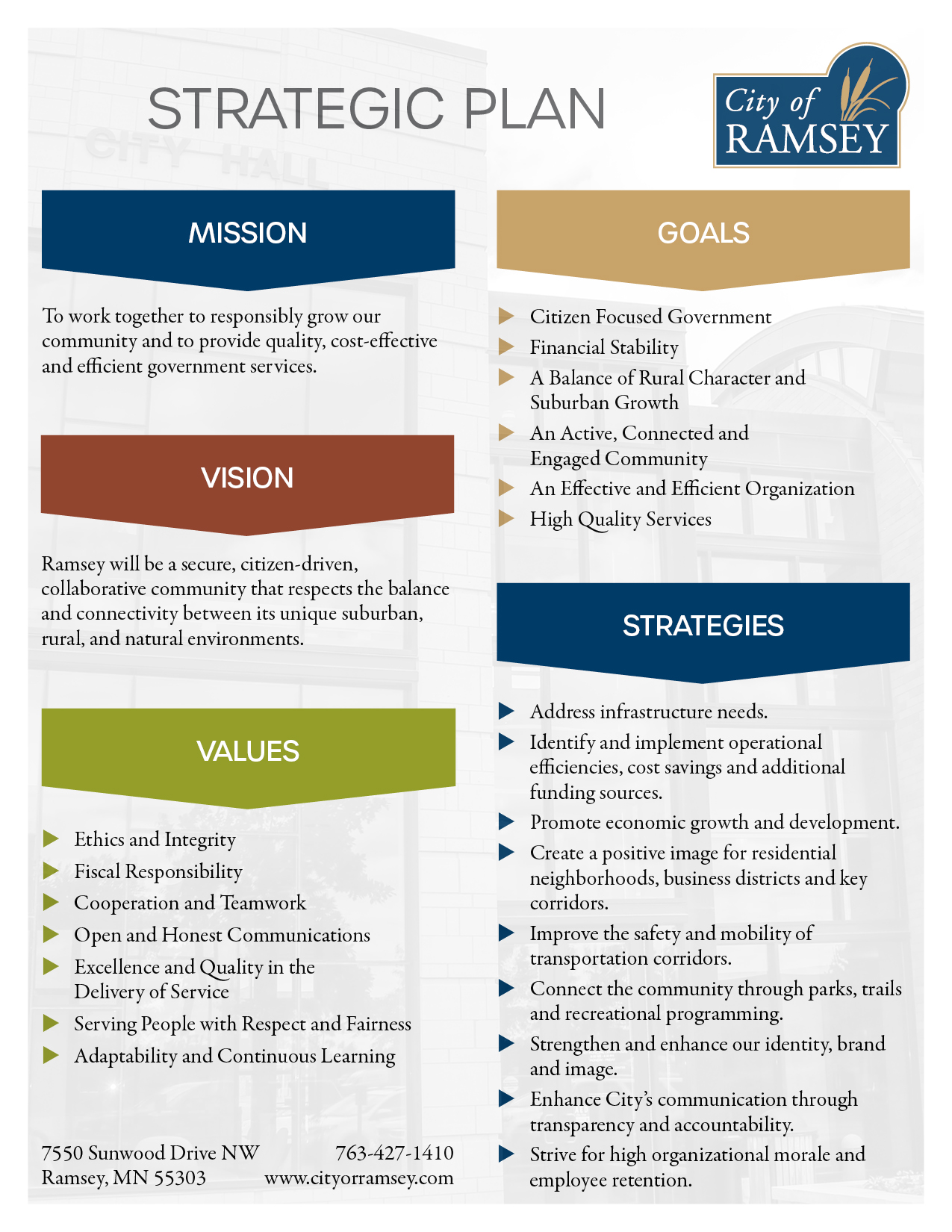
Ramsey will be a secure, citizen-driven, collaborative community that respects the balance and connectivity between its unique suburban, rural, and natural environments.
- Ethics and Integrity
- Fiscal Responsibility
- Cooperation and Teamwork
- Open and Honest Communications
- Excellence and Quality in the Delivery of Service
- Serving People with Respect and Fairness
- Adaptability and Continuous Learning
- Citizen-Focused Government
- Financial Stability
- A Balance of Rural Character and Suburban Growth
- An Active, Connected and Engaged Community
- An Effective and Efficient Organization
- High Quality Services
- Address infrastructure needs.
- Identify and implement operational efficiencies, cost savings and additional funding sources.
- Promote economic growth and development.
- Create a positive image for residential neighborhoods, business districts and key corridors.
- Improve the safety and mobility of transportation corridors.
- Connect the community through parks, trails and recreational programming.
- Strengthen and enhance our identity, brand and image.
- Enhance City’s communication through transparency and accountability.
- Strive for high organizational morale and employee retention.
Adopted Strategic Plan
The City Council adopted the 2026 Strategic Plan on April 28, 2026
Mayor
- Ryan Heineman
Councilmembers
- Chris Riley, At-Large
- Kirsten Buscher, At-Large
- Michael Olson, Ward 1
- Eric Peters, Ward 2
- Dan Specht, Ward 3
- Shanna Stewart, Ward 4
The City of Ramsey’s Strategic Planning Session allowed for council and staff to review and plan for the future needs of the city. The session reflected on past accomplishments in order to establish framework on how to proceed forward. In looking to the future needs of the city, opportunities and challenges are identified for the purpose of setting goals to strive towards accomplishing. The outcome of the session guides city officials on completing projects to better the community while staying true to the mission, vision and values of the city.
Mission
To work together to responsibly grow our community and to provide quality, cost-effective and efficient government services.
Vision
Ramsey will be a secure, citizen-driven, collaborative community that respects the balance and connectivity between its unique suburban, rural and natural environments.
Values
- Ethics and Integrity
- Fiscal Responsibility
- Cooperation and Teamwork
- Open and Honest Communications
- Excellence and Quality in the Delivery of Service
- Serving People with Respect and Fairness
- Adaptability and Continuous Learning
Goals
- Citizen Focused Government
- Financial Stability
- A Balance of Rural Character and Suburban Growth
- An Active, Connected and Engaged Community
- An Effective and Efficient Organization
- High Quality Services
Strategies
- Address infrastructure needs
- Identify and implement operational efficiencies, cost savings or additional funding sources
- Promote economic growth and development
- Create a positive image for residential neighborhoods, business districts and key corridors
- Improve the safety and mobility of transportation corridors
- Connect the community through Parks, Trails and Recreational Programming
- Strengthen and enhance our identity, brand and image
- Enhance City’s communication through transparency and accountability
- Strive for high organizational morale and employee retention
Reflection Activities
Attendees participated in four activities, which allowed for time to reflect on how the organization is doing. The activities focused on what was working well, what was not working well, what the city was not doing that it should be doing, and what the city was doing that it should not be doing. As identified in 2025:
What’s working well?
- Decreased staff turnover
- Positive staff morale as shown through reduced turnover rates from 2022/2023
- Pavement management plan
- Social media presence
- Community events
- Recreation programming
- Playground replacement program
- Commercial/industrial growth
- Fire service model
- COR shovel-ready sites
- Internal relationships across departments
- City Council/Boards & Commissions preparedness
- Agenda preparation by staff
- City decorations (i.e., lights on trees in the COR)
- Council/staff relations
- Public Safety communication of major events
- Laserfiche Workflow implementation (Ramsey staff lead project)
- Electronic records management
- Work Session efficiency
- RALF Property Sales
- Assessment and Adjustment of Operational Needs
- Historic Town Hall Project
What’s not work well?
- Large levy increases
- Challenge of incorporating public safety requests into the budget in relation to the needs of the entire city
- Future Capital Purchase funding status
- Social media strategy (amount of content for limited pages)
- Mississippi River Bridge Crossing
- Community volunteers and public recognition
- Long-Term Road Funding Balance vs. Project Needs
What are we not doing that we should be doing?
- Gaining utility connections on commercial properties when private systems fail
- Asset management system (infrastructure, vehicles, equipment)
- GIS tools
- Improving facility security monitoring
- Residential facade improvement program
- Using new technology
- Recycling & Compost Facility
Areas for Improvement?
- Team Building
- Promoting Employee Wellness
Attendees then looked to the future to review opportunities and impacts the city will face in the next one to five years. The purpose of this exercise was to be cognizant of what to expect as we plan for our future in order to be forward-thinking.
Opportunities in the next 1-5 years
- Mississippi River Bridge planning
- Process improvements with smart technology
- COR Development of public and privately owned parcels
- RALF property (Hwy 10) redevelopment
- City identity/Hwy 10 image
- Historic Town Hall Restoration
- Youth Athletics
- New Park Improvements
- Elk River Hwy 10 Planning
Impacts in the next 1-5 years
- Finishing Waterfront Park
- Cannabis laws
- Comprehensive Plan Amendment process (start in 2026)
- Staffing needs
- Management staff retirements
- Reaching 30,000 population
- Public Transportation model
- COR Development and traffic counts
- State adopted local zoning control regulations
- Federal and State funding opportunities
- Petitions on taxable market values
- Elk River Highway 10 project
- Changing demographics
- Increasing public safety calls
- Aging City facilities
- City Facility Space Needs
2026 Key Strategies & Action Steps
Key Strategies
Strategy 1. Address infrastructure needs
- Objective 1: Ensure existing infrastructure remains high quality to maximize useful life
- Responsible Parties: Engineering, Public Works (Westby, Riverblood)
- Key Areas: City-owned facilities, parks, streets, trails, utilities
- Action 1.1: Inspect all infrastructure routinely
- Action 1.2: Inspect utilities during design of Pavement Management Program (PMP) projects
- Action 1.3: Complete PMP improvement/maintenance projects annually
- Action 1.4: Explore singular Asset Management Program for city-wide use (Q2 2027)
- Action 1.5: Complete well-siting study for Well #9 (Q2 2026)
- Performance Indicator: Maintain or improve infrastructure quality
- Completion Timeframe: Ongoing, unless otherwise noted above
- Objective 2: Determine future city facility needs
- Responsible Parties: Administration, Fire, Police, Public Works (Hagen, Kohner, Bluml, Westby)
- Key Areas: City buildings where offices are, and equipment is stored
- Action 2.1: Assess maintenance needs of existing facilities
- Action 2.2: Prioritize/budget for maintenance needs of facilities
- Action 2.3: Assess current and future space needs
- Action 2.4: Explore options to repurpose existing facilities to meet the city’s needs or construct a new facility(s) to meet future growth needs
- Performance Indicator: Maintain or improve infrastructure quality
- Completion Timeframe: Q3 2026
Strategy 2. Identify and implement operational efficiencies, cost savings or additional funding sources
- Objective 1: Implement software programs to reduce inefficiencies
- Responsible Parties: All Departments (Department Heads)
- Key Areas: Software programs to aid in operational duties
- Action 1.1: Identify operations where software implementation would provide efficiencies and reduce potential for error by reducing data entry processes (HR, Asset Mgmt, etc.)
- Action 1.2: Identify program options available and check comparable city references on the program
- Action 1.3: Establish implementation plan with Ramsey IT staff
- Action 1.4: Determine available 2025 funding and budget accordingly for 2026 and beyond
- Performance Indicator: Reduced redundancy in staff’s tasks by eliminating manual entry/tracking in Excel spreadsheets
- Completion Timeframe: Ongoing
- Objective 2: Utilize grant funding opportunities
- Responsible Parties: All Departments
- Key Areas: Projects and equipment purchases
- Action 2.1: Identify new grant opportunities utilizing different measures to find the opportunities (i.e., AI)
- Action 2.2: Identify projects or equipment purchases where historical grant funding opportunities have been available
- Action 2.3: Recognize potential grant funding availability as a potential funding source in CIP
- Action 2.4: Apply for grant funds in conjunction with establishing funding sources
- Action 2.5: Identify grant writing training classes for staff to complete
- Performance Indicator: Increased grant-funded projects/purchases
- Completion Timeframe: Ongoing
- Objective 3: Solicit ideas from all staff on improving operational efficiency and cost-saving options.
- Responsible Parties: All Departments
- Key Areas: Day-to-day operations
- Action 3.1: Organize feedback opportunities for staff to share ideas
- Action 3.2: Recognize staff whose ideas are implemented into operations
- Performance Indicator: Approval of operational changes
- Completion Timeframe: Ongoing, recognize staff semi-annually at all staff meetings
- Objective 4: Increase community volunteer engagement.
- Responsible Parties: Administration, Parks and Recreation
- Key Areas: Events, services and community cleanup
- Action 4.1: Develop comprehensive list of volunteer opportunities
- Action 4.2: Create webpage and signup process to track opportunities and committed volunteer hours
- Action 4.3: Conduct volunteer satisfaction survey
- Action 4.4: Track volunteered hours and provide recognition to those who served the community
- Action 4.5: Review 2025 improved volunteer engagement efforts in Q1 2026 and implement additional improvements
- Performance Indicator: Number of volunteers, volunteer retention rate, volunteer satisfaction
- Completion Timeframe: Ongoing, recognize volunteers annually
- Objective 5: Determine necessary Public Safety mental health response resources
- Responsible Parties: Police Department
- Key Areas: Mental health support during emergency response calls
- Action 5.1: Review other municipalities’ operations as they relate to mental health resources during emergency response calls
- Action 5.2: Review resources available through the Anoka County Sheriff’s Office to aid during emergency response calls
- Action 5.3: Consider and establish additional resources for 2027 budget
- Performance Indicator: Increased mental health response resources.
- Completion Timeframe: Q2 2026
Strategy 3. Promote economic growth and development
- Objective 1: Develop and implement commercial property public utility connection program
- Responsible Parties: Economic Development, Engineering (Sullivan, Hanson, Westby)
- Key Areas:
- Action 1.1: Compile or create utility information
- Action 1.2: Produce utility information within GIS system (note that current LOGIS contract and Ramsey staffing are insufficient to complete this)
- Action 1.3: Identify commercial properties with available public utilities that are not connected
- Action 1.4: Identify commercial properties with available public utilities close by that are not connected
- Action 1.5: Identify TIF-funded utility improvements
- Action 1.6: Create an incentive program/policy with a funding source to encourage connection to public utilities
- Performance Indicator: Reduce private systems on commercial properties where public utilities are available.
- Completion Timeframe: Q4 2026
- Objective 2: Conduct business retention and expansion efforts
- Responsible Parties: Economic Development (Sullivan)
- Key Areas: Existing businesses
- Action 2.1: Conduct 30 in-person business visits
- Action 2.2: Host Business Networking Event
- Action 2.3: Host Business Expo Event
- Action 2.4: Host Business Appreciation Golf Event
- Performance Indicator: Sold out or increased attendance
- Completion Timeframe: Annually
- Objective 3: Sell/Redevelop RALF - Turn-back Properties on Highway 10
- Responsible Parties: Economic Development, Planning (Sullivan, Hanson, Larson)
- Key Areas:
- Action 3.1: Work with Met Council, MNDot and Anoka County to Process Turn-back Process
- Action 3.2: Obtain Appraisals/or valuations for RALF/Turn-back properties
- Action 3.3: Evaluate contiguous development site options for development/redevelopment
- Action 3.4: List RALF/Turn-back on MNCAR
- Performance Indicator: Turn-backs processed, Sale of Parcels / Increase Tax Base / Creation of Jobs
- Completion Timeframe: Turn-backs Q3 2026, Sale of Parcels Q4 2028
Strategy 4. Create a positive image for residential neighborhoods, business districts and key corridors
- Objective 1: Improve the image of Ramsey along the Hwy 10 Corridor
- Responsible Parties: Community Development (Hanson, Larson)
- Key Areas: Existing commercial properties visible from Hwy 10
- Action 1.1: Follow the Improve the Image of Ramsey Along the Highway 10 Corridor Policy
- Action 1.2:
- Action 1.3: Work in tandem with ED Manager on business visits to communicate violations, and collaboratively work with them on cleanup efforts
- Action 1.4: Identify potential redevelopment properties
- Performance Indicator: Reduce blighted properties along Hwy 10
- Completion Timeframe: Ongoing
- Objective 2: Implement Home Improvement Incentive Program
- Responsible Parties: Community Development (Hanson, Sullivan, Larson)
- Key Areas: Single-Family Residential Homes Meeting the Income Restrictions
- Action 2.1: Adopt final policy for the program Q2 2026
- Action 2.2: Advertise the program
- Action 2.3: Review applications and award funding
- Action 2.4: Periodically review program for effectiveness and improvements
- Performance Indicator: Maintained homes, providing higher-quality living conditions.
- Completion Timeframe: Ongoing, subject to the Local Affordable Housing Aid funding source
- Objective 3: Rehabilitate Historic Town Hall
- Responsible Parties: Economic Development (Sullivan, Hanson)
- Key Areas: Historic Town Hall
- Action 3.1: Complete preliminary design of rehabilitation improvements
- Action 3.2: Apply for large grant opportunity to complete the construction improvements
- Action 3.3: Identify user/renter
- Performance Indicator: Acquire grant funds to fund remaining allowed construction costs, complete the construction improvements and identify user
- Completion Timeframe: Q1 2028
- Objective 4: Earth Day Cleanup
- Responsible Parties: Parks and Recreation (Riverblood)
- Key Areas: Parks, Trails or major corridors
- Action 4.1: Solicit staff interest to partake in a partial-day cleanup effort of the City’s public areas
- Action 4.2: Conduct cleanup of public areas on Earth Day or an alternate day due to weather
- Performance Indicator: Staff participation.
- Completion Timeframe: Annually
Strategy 5. Improve the safety and mobility of transportation corridors
- Objective 1: Improve street lighting and pedestrian facilities
- Responsible Parties: Engineering, Public Works (Westby)
- Key Areas: Existing and future roadways and pedestrian facilities
- Action 1.1: Evaluate and construct street lighting improvements
- Action 1.2: Evaluate and construct pedestrian trail safety improvements
- Performance Indicator: Reduction in reported safety concerns
- Completion Timeframe: Ongoing
Strategy 6. Connect the community through parks, trails and recreational programming
- Objective 1: Construct Phase 1 of The Waterfront Park
- Responsible Parties: Parks Division (Riverblood)
- Key Areas: COR Community Park and Downtown Destination
- Action 1.1: Approve schematic design work of water play area and future community building, June 10, 2025
- Action 1.2: Authorize preparation of plans/specs August 12, 2025
- Review comparative case studies of comparable community buildings/parks
- Review comprehensive proforma of The Waterfront Park (revenue/O&M costs)
- Identify funding and community benefits
- Approve schematic design and phasing plan
- Action 1.3: Approve plans/specs and authorize bids September 2025 (3-month process)
- Action 1.4: Award contract January 2026
- Action 1.5: Monitor construction progress to prevent delays
- Performance Indicator: Water play opens July 1, 2026
- Completion Timeframe: Phase 1 completed Q2 2026
Strategy 7. Strengthen and enhance our identity, brand and image
- Objective 1: Secure Ramsey Zip Code
- Responsible Parties: Administration (Hagen)
- Key Areas:
- Action 1.1: Identify key personnel at USPS to discuss obtaining a unique zip code
- Action 1.2: Identify other influential parties to support Ramsey’s efforts
- Action 1.3: Host critical meetings to develop the timing and formal application procedure to prevent an immature application from occurring
- Performance Indicator: Known metrics are understood on what USPS uses when considering a new zip code.
- Completion Timeframe: Formal request may be submitted to district manager in 2026
- Objective 2: Enhance City brand
- Responsible Parties: Communications (Johnson)
- Key Areas: Branding and communications strategy
- Action 2.1: Create City Motto
- Action 2.2: Create Branding Guide for staff to use with templates and logos
- Performance Indicator:
- Completion Timeframe: Q1 2027
Strategy 8. Enhance the City’s communication through transparency and accountability
- Objective 1: Identify and advertise a cost savings measure
- Responsible Parties: Administration (Hagen)
- Key Areas: All city operations
- Action 1.1: Advertise through the newsletter or social media an area of improvement that reduced costs through direct savings or improved efficiency.
- Performance Indicator: Public engagement reaction to the advertised measure
- Completion Timeframe: Minimum one item per year
- Objective 2: Positive, proactive and time-relevant communication
- Responsible Parties: Communications (Johnson)
- Key Areas: Public-facing communication strategy
- Action 2.1: Assess the effectiveness of the city’s current social media presence and the need for additional department-specific pages
- Action 2.2: Explore new avenues to tell the story of Ramsey and market the community to new residents and businesses
- Action 2.3: Enhance how social media is utilized
- Performance Indicator: Public engagement through social media
- Completion Timeframe: Ongoing
- Objective 3: Develop and publish trail maintenance schedule/map
- Responsible Parties: Parks Division (Riverblood)
- Key Areas: Long-term trail maintenance plan
- Action 3.1: Develop a 10-year trail maintenance needs schedule
- Action 3.2: Establish estimated funding needs to complete the plan
- Action 3.3: Implement maintenance schedule into CIP document
- Action 3.4: Create 10-year trail maintenance CIP map and post to city website
- Performance Indicator: Creation of plan/map and incorporation into 10-year CIP
- Completion Timeframe: Final 2027 Budget/Levy Adoption
Strategy 9. Strive for high organizational morale and employee retention
- Objective 1: Expand employee wellness efforts
- Responsible Parties: Human Resources (Lasher)
- Key Areas: Employee health
- Action 1.1: Expand upon Gallagher Benefit Services Wellness Programming
- Action 1.2: Increase engagement in Employee Lunch & Learns
- Performance Indicator: Improved group insurance renewal rating
- Completion Timeframe: Ongoing
- Objective 2: Expand employee engagement
- Responsible Parties: Human Resources (Colleen Lasher)
- Key Areas: Employee engagement
- Action 2.1: Implement simplified performance evaluation process to track employee goals, notify of deadlines and integrate into records management system
- Action 2.2: Conduct voluntary stay interviews or dedicated roundtable discussion opportunities to receive feedback outside of routine all staff surveys
- Action 2.3: Offer additional voluntary gatherings that incorporate opportunities for staff to communicate with management
- Performance Indicator: Increased positive ratings/comments shown in the employee survey
- Completion Timeframe: Ongoing
- Objective 3: Expand employee appreciation efforts
- Responsible Parties: Human Resources (Colleen Lasher)
- Key Areas: Employee appreciation and recognition
- Action 3.1: Provide branded items to staff commonly used during and for work (name badge lanyards, water bottles, pens, etc.)
- Action 3.2: Implement additional themed days/activities throughout the year
- Action 3.3: Continue existing employee engagement events (2 all staff meetings, popcorn Wednesdays, birthday treats, potlucks, ice cream social)
- Performance Indicator: Employee attendance at events, staff survey feedback
- Completion Timeframe: Ongoing
2025 KEY STRATEGIES & ACTION STEPS ACCOMPLISHED
Strategy: Address infrastructure needs
- Objective 1: Identify infrastructure maintenance needs
- Responsible Parties: Streets, Parks, Engineering (Bruce Westby, Mark Riverblood)
- Key Areas: pavement maintenance, water/sewer/storm sewer infrastructure, parks and trails
- Action 1.1: Determine short-term annual pavement maintenance needs
- The city increased their annual funding in 2023 to complete various projects for temporary pavement repairs. The focus was to complete repairs on certain roadways that would see a larger maintenance project in the coming years. Various projects were completed from intersection mill & overlays, skim patching larger stretches of roadways and patching potholes throughout the city. Staff have continued to monitor these efforts to determine the success and life of these repairs. Subsequent annual budgets have received proper general funding expenditures to continue these efforts.
- Action 1.2: Inspect and determine need of maintenance of underground infrastructure prior to major projects.
- As part of major street maintenance projects, inspection of unground infrastructure has occurred and been implemented into plans to prevent future scenarios requiring roads to be tore apart before their useful life has reached the end.
- Action 1.3: Complete PMP improvement/maintenance projects annually
Strategy: Identify and implement operational efficiencies, cost savings or additional funding sources
- Objective 1: Implement software programs to reduce inefficiencies
- Responsible Parties: All Departments
- Key Areas: Software programs to aid in operational duties
- Action 1.1: Identify software to provide efficiency and reduced potential for error
- HR has begun a multi-year, phased implementation of HR software to aid in recruitment, onboarding and ongoing performance evaluations.
- Action 1.1: Identify software to provide efficiency and reduced potential for error
- Objective 2: Utilize grant funding opportunities
- Responsible Parties: All Departments
- Key Areas: Projects and equipment purchases
- Action 2.4: Apply for grants in conjunction with establishing funding sources
- The city received grant funding or donated items to support the Historic Town Hall Project, Waterfront Park (fishing pier and stocked fish) and the PD’s Drone Program
- Action 2.5: Identify grant writing training classes for staff to complete
- Three public works and one engineering staff completed courses.
- Action 2.4: Apply for grants in conjunction with establishing funding sources
Strategy: Promote economic growth and development
- Objective 1: Continue Business Retention and Expansion efforts for retail and industrial
- Responsible Parties: Economic Development (Sean Sullivan, EDA)
- Key Areas: promoting private businesses
- Action 1.1: Conduct business retention visits
- 30 in-person visits are targeted each year, with many informal communications occurring as well.
- Action 1.2: Improve the quality and attendance at EDA events
- The business appreciation golf event historically sees full registration of 144 golfers, plus additional meal-only tickets purchased. The Business Expo continues to see an increase of Ramsey businesses attending. The Business Networking breakfast consistently experiences 120 plus attendees.
- Action 1.3: Business expansions saw 17K sq. ft. of retail, 71K sq. ft. of commercial and 68K sq. ft. of industrial in 2025.
- Action 1.1: Conduct business retention visits
Strategy: Create a positive image for residential neighborhoods, business districts and key corridors
- Objective 1: Improve the image of Ramsey along the Hwy 10 Corridor
- Responsible Parties: Community Development
- Key Areas: Existing commercial properties visible from Hwy 10
- A policy has been adopted outlining the goal and process of the proactive code enforcement along Hwy 10. A letter has been sent to all businesses, and code enforcement is beginning site visits to meet property owners in Spring 2026.
- Objective 3: Rehabilitate Historic Town Hall
- Responsible Parties: Economic Development
- Key Areas: Historic Town Hall
- A small grant was received to prepare construction plans that will render the building usable, while maintaining the historic significance of the site in order for it to remain on the National Register of Historic Places.
Strategy: Connect the community through parks, trails and recreational programming
- Objective 1: Construct Phase 1 of The Waterfront Park
- Responsible Parties: Parks Division
- Key Areas: COR Community Park and Downtown Destination
- The project is on track to be completed on July 1, 2026.
2025 Key Strategies & Action Steps
Strategy 1. Address infrastructure needs
- Objective 1: Ensure existing infrastructure remains high quality to maximize useful life
- Responsible Parties: Engineering, Public Works (Westby, Riverblood)
- Key Areas: City-owned facilities, parks, streets, trails, utilities
- Action 1.1: Inspect all infrastructure routinely
- Action 1.2: Inspect utilities during design of Pavement Management Program (PMP) projects
- Action 1.3: Complete PMP improvement/maintenance projects annually
- Action 1.4: Explore singular Asset Management Program for city-wide use (Q3 2025)
- Action 1.5: Complete well-siting study for Well #9 (Q4 2025)
- Performance Indicator: Maintain or improve infrastructure quality
- Completion Timeframe: Ongoing, unless otherwise noted above
- Objective 2: Determine future city facility needs
- Responsible Parties: Administration, Fire, Police, Public Works (Hagen, Kohner, Bluml, Westby)
- Key Areas: City buildings where offices are and equipment is stored
- Action 2.1: Assess maintenance needs of existing facilities
- Action 2.2: Prioritize/budget for maintenance needs of facilities
- Action 2.3: Assess current and future space needs
- Action 2.4: Explore options to repurpose existing facilities to meet the city's needs or construct a new facility(s) to meet future growth needs
- Performance Indicator: Maintain or improve infrastructure quality
- Completion Timeframe: Q1 2026
Strategy 2. Identify and implement operational efficiencies, cost savings or additional funding sources
- Objective 1: Implement software programs to reduce inefficiencies
- Responsible Parties: All Departments (Department Heads)
- Key Areas: Software programs to aid in operational duties
-
-
- Action 1.1 Identify operations where software implementation would provide efficiencies and reduce potential for error by reducing data entry processes (HR, Asset Mgmt, etc.)
- Action 1.2: Identify program options available and check comparable city references on the program
- Action 1.3: Establish implementation plan with Ramsey IT staff
- Action 1.4: Determine available 2025 funding and budget accordingly for 2026 and beyond
- Performance Indicator: Reduced redundancy in staff’s tasks by eliminating manual entry/tracking in Excel spreadsheets
- Completion Timeframe: Ongoing
-
- Objective 2: Utilize grant funding opportunities
- Responsible Parties: All Departments
- Key Areas: Projects and equipment purchases
- Action 2.1: Identify new grant opportunities utilizing different measures to find the opportunities (i.e., AI)
- Action 2.2: Identify projects or equipment purchases where historical grant funding opportunities have been available
- Action 2.3: Recognize potential grant funding availability as potential funding source in CIP
- Action 2.4: Apply for grant funds in conjunction with establishing funding sources
- Action 2.5: Identify grant writing training classes for staff to complete
- Performance Indicator: Increased grant funded projects/purchases
- Completion Timeframe: Ongoing
- Objective 3: Solicit ideas from all staff on improving operational efficiencies and cost savings options.
- Responsible Parties: All Departments
- Key Areas: Day-to-day operations
- Action 3.1: Organize feedback opportunities for staff to share ideas
- Action 3.2: Recognize staff whose ideas are implemented into operations
- Performance Indicator: Approval of operational changes
- Completion Timeframe: Ongoing, recognize staff semi-annually at all staff meetings
- Objective 4: Increase community volunteer engagement.
- Responsible Parties: Administration, Parks and Recreation
- Key Areas: Events, services and community cleanup
- Action 4.1: Develop comprehensive list of volunteer opportunities
- Action 4.2: Create webpage and signup process to track opportunities and committed volunteer hours
- Action 4.3: Conduct volunteer satisfaction survey
- Action 4.4: Track volunteered hours and provide recognition to those who served the community
- Action 4.5: Review 2025 improved volunteer engagement efforts in Q1 2026 and implement additional improvements
- Performance Indicator: Number of volunteers, volunteer retention rate, volunteer satisfaction
- Completion Timeframe: Ongoing, recognize volunteers annually
- Objective 5: Determine necessary Public Safety mental health response resources
- Responsible Parties: Police Department
- Key Areas: Mental health support during emergency response calls
- Action 5.1: Review other municipality’s operations as it relates to mental health resources during emergency response calls
- Action 5.2: Review resources available through Anoka County Sheriff’s Office to aid during emergency response calls
- Action 5.3: Consider and establish additional resources for 2027 budget
- Performance Indicator: Increased mental health response resources.
- Completion Timeframe: Q2 2026
Strategy 3. Promote economic growth and development
- Objective 1: Develop and implement commercial property public utility connection program
- Responsible Parties: Economic Development, Engineering (Sullivan, Hanson, Westby)
- Key Areas:
- Action 1.1: Identify commercial properties with available public utilities that are not connected
- Action 1.2: Identify commercial properties with available public utilities close by that are not connected
- Action 1.3: Identify TIF-funded utility improvements
- Action 1.4: Create an incentive program/policy with a funding source to encourage connection to public utilities
- Performance Indicator: Reduce private systems on commercial properties where public utilities are available.
- Completion Timeframe: Q3 2025
- Objective 2: Conduct business retention and expansion efforts
- Responsible Parties: Economic Development (Sullivan)
- Key Areas: Existing businesses
- Action 2.1: Conduct 30 in-person business visits
- Action 2.2: Host Business Networking Event
- Action 2.3: Host Business Expo Event
- Action 2.4: Host Business Appreciation Golf Event
- Performance Indicator: Sold out or increased attendance
- Completion Timeframe: Annually
Strategy 4. Create a positive image for residential neighborhoods, business districts and key corridors
- Objective 1: Improve the image of Ramsey along the Hwy 10 Corridor
- Responsible Parties: Community Development (Hanson, Larson)
- Key Areas: Existing commercial properties visible from Hwy 10
- Action 1.1: Identify businesses with noncompliant code violations
- Action 1.2: Identify businesses in violation of approved CUPs
- Action 1.3: Work in tandem with ED Manager on business visits to communicate violations, and collaboratively work with them on cleanup efforts
- Action 1.4: Identify potential redevelopment properties
- Performance Indicator: Reduce blighted properties along Hwy 10
- Completion Timeframe: Q4 2025
- Objective 2: Rehabilitate Historic Town Hall
- Responsible Parties: Economic Development (Sullivan, Hanson)
- Key Areas: Historic Town Hall
- Action 2.1: Complete preliminary design of rehabilitation improvements
- Action 2.2: Apply for large grant opportunity
- Action 2.3: Apply for small grant opportunities if needed
- Action 2.4: Identify user/renter
- Performance Indicator: Acquire grant funds to fund remaining allowed construction costs
- Completion Timeframe: Q1 2026
Strategy 5. Improve the safety and mobility of transportation corridors
- Objective 1: Improve street lighting and pedestrian facilities
- Responsible Parties: Engineering, Public Works (Westby)
- Key Areas: Existing and future roadways and pedestrian facilities
- Action 1.1: Evaluate and construct street lighting improvements
- Action 1.2: Evaluate and construct pedestrian trail safety improvements
- Performance Indicator: Reduction in reported safety concerns
- Completion Timeframe: Ongoing
Strategy 6. Connect the community through parks, trails and recreational programming
- Objective 1: Construct Phase 1 of The Waterfront Park
- Responsible Parties: Parks Division (Riverblood)
- Key Areas: COR Community Park and Downtown Destination
- Action 1.1: Approve schematic design work of water play area and future community building, June 10, 2025
- Action 1.2: Authorize preparation of plans/specs August 12, 2025
- Review comparative case studies of comparable community buildings/parks
- Review comprehensive proforma of The Waterfront Park (revenue/O&M costs)
- Identify funding and community benefits
- Approve schematic design and phasing plan
- Action 1.3: Approve plans/specs and authorize bids September 2025 (3-month process)
- Action 1.4: Award contract January 2026
- Performance Indicator: Water play opens July 1, 2026
- Completion Timeframe: Phase 1 completed Q2 2026
- Objective 2: Develop and commit to a final plan for The Waterfront Park
- Responsible Parties: Parks Division (Riverblood)
- Key Areas: COR Community Park and Downtown Destination
- Action 2.1: This objective runs in conjunction with Strategy 6, Objective 1, Action items 1.1 and 1.2.
- Action 1.2: Establish future community building amenities
- Action 1.3: Establish phasing plan for completing the Waterfront Park
- Action 1.4: Authorize preparation of plans/specs for community building – date TBD
- Action 1.5: Approve plans/specs and authorize bids for awarding a construction contract – date TBD
- Performance Indicator: Approved schematic design for entire Waterfront Park and phasing plan.
- Completion Timeframe: Q3 2025
Strategy 7. Strengthen and enhance our identity, brand and image
- Objective 1: Secure Ramsey Zip Code
- Responsible Parties: Administration (Hagen)
- Key Areas:
- Action 1.1: Identify key personnel at USPS to discuss obtaining a unique zip code
- Action 1.2: Identify other influential parties to support Ramsey’s efforts
- Action 1.3: Host critical meetings to develop the timing and formal application procedure to prevent an immature application from occurring
- Performance Indicator: Known metrics are understood on what USPS uses when considering a new zip code.
- Completion Timeframe: Formal request may be submitted to district manager in 2026
- Objective 2: Enhance City brand
- Responsible Parties: Communications (Johnson)
- Key Areas: Branding and communications strategy
- Action 2.1: Create City Moto
- Action 2.2: Create Branding Guide for staff to use with templates and logos
- Performance Indicator:
- Completion Timeframe: Q1 2026
Strategy 8. Enhance City’s communication through transparency and accountability
- Objective 1: Identify and advertise a cost savings measure
- Responsible Parties: Administration (Hagen)
- Key Areas: All city operations
- Action 1.1: Advertise through newsletter or social media an area of improvement that decreased cost through direct savings or improved efficiency.
- Performance Indicator: Public engagement reaction to the advertised measure
- Completion Timeframe: Minimum one item per year
- Objective 2: Positive, proactive and time-relevant communication
- Responsible Parties: Communications (Johnson)
- Key Areas: Public-facing communication strategy
- Action 2.1: Assess the effectiveness of the city’s current social media presence and the need for additional department-specific pages
- Action 2.2: Explore new avenues to tell the story of Ramsey and market the community to new residents and businesses
- Action 2.2:
- Action 2.3: Enhance how social media is utilized
- Action 2.3: Consider additional communications personnel with focus on social media marketing
- Performance Indicator: Public engagement through social media
- Completion Timeframe: Ongoing
- Objective 3: Develop and publish trail maintenance schedule/map
- Responsible Parties: Parks Division (Riverblood)
- Key Areas: Long-term trail maintenance plan
- Action 3.1: Develop a 10-year trail maintenance needs schedule
- Action 3.2: Establish estimated funding needs to complete the plan
- Action 3.3: Implement maintenance schedule into CIP document
- Action 3.4: Create 10-year trail maintenance CIP map and post to city website
- Performance Indicator: Creation of plan/map and incorporation into 10-year CIP
- Completion Timeframe: Final 2026 Budget/Levy Adoption
- Objective 4: Conduct Citizen Survey
- Responsible Parties: Administration
- Key Areas: Monitor community satisfaction on city operations and services
- Action 4.1: Review past survey results
- Action 4.2: Establish questions for 2026 survey
- Action 4.3: Conduct third-party survey and review results for guidance on future operations
- Performance Indicator: Increased community satisfaction as compared to historical results.
- Completion Timeframe: Q2 2026
Strategy 9. Strive for high organizational morale and employee retention
- Objective 1: Expand employee wellness efforts
- Responsible Parties: Human Resources (Lasher)
- Key Areas: Employee health
- Action 1.1: Expand upon Gallagher Benefit Services Wellness Programming
- Action 1.2: Increase engagement in Employee Lunch & Learns
- Action 1.3: Identify fitness options for City Hall staff similar to what’s available to PD, FD, PW
- Action 1.4: Increase wellness activities
- Performance Indicator: Improved group insurance renewal rating
- Completion Timeframe: Ongoing
- Objective 2: Expand employee engagement
- Responsible Parties: Human Resources (Colleen Lasher)
- Key Areas: Employee engagement
- Action 2.1: Implement simplified performance evaluation process to track employee goals, notify of deadlines and integrate into records management system
- Action 2.2: Conduct voluntary stay interviews or dedicated roundtable discussion opportunities to receive feedback outside of routine all-staff surveys
- Performance Indicator:
- Completion Timeframe: Ongoing
- Objective 3: Expand employee appreciation efforts
- Responsible Parties: Human Resources (Colleen Lasher)
- Key Areas: Employee appreciation and recognition
- Action 3.1: Provide branded items to staff commonly used during and for work (name badge lanyards, water bottles, pens, etc)
- Action 3.2: Implement additional themed days/activities throughout the year
- Action 3.3: Continue existing employee engagement events (2 all staff meetings, popcorn Wednesdays, birthday treats, potlucks, ice cream social)
- Performance Indicator: Employee attendance at events, staff survey feedback
- Completion Timeframe: Ongoing
Sign up to our Newsletter
Stay up to date on the city's activities, events, programs and operations by subscribing to our eNewsletters.