Oak Wilt

Oak Wilt is a disease of oak trees caused by a non-native fungus known as Ceratocystis fagacearum. The fungus invades a tree's vascular system, or xylem, which includes the water-conducting vessels that transport water up to the tree's canopy from the roots.

As a defense mechanism, an infected tree produces substances in the xylem to block the fungus from spreading throughout the tree. In reality, these substances clog the water-conducting vessels, preventing water from reaching the canopy (leaves) of the tree. Eventually, most infected trees die due to an oak wilt infection.

The USDA Forest Service Eastern Region has developed a Story Map to provide a comprehensive overview of Oak Wilt signs, symptoms, and management strategies.  

Affected Trees

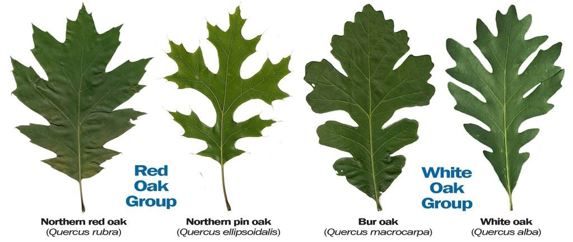
All types of oak trees found in Minnesota are affected by oak wilt. However, some oak species are more resistant to the disease than others. Generally, oaks can be placed into two groups: red oak (leaves with pointed lobes) and white oak (leaves with rounded lobes).

Red Oak

The red oak group includes red oak (Quercus rubra) and northern pin oak (Quercus ellipsoidalis), both of which are highly susceptible to oak wilt. Trees in this group can succumb to the disease in as little as a few weeks to a few months. Once a tree in the red oak group is infected, no current treatment can save or “cure” it.

White Oak

The white oak group, which includes bur oak (Quercus macrocarpa), white oak (Quercus alba), and bicolor oak (Quercus bicolor), is susceptible to oak wilt. Still, these species can withstand the disease for extended periods (usually 1 to several years). Furthermore, if an infected tree in the white oak group is identified and chemically treated early enough, it can often be preserved.

The following images offer comparisons of oak leaves.

Examples of healthy oak leaves. Photo Credits: 1-3: Katy Chayka, minnesotawildflowers.info; 4: Smithsonian Gardens, gardens.si.edu

Photo leaves of a northern red oak, northern pin oak, bur oak and white oak


The fungus that causes Oak Wilt can spread in one of two ways.

Overland Sap-Feeding Insects

First, the fungus can be spread overland through various sap-feeding insects. Infected trees in the red oak family have the potential to produce spore mats the year following infection (the white oak family of trees does not produce spore mats). Certain insects are attracted to the fruity aroma produced by these mats.

As insects contact the spore mat, fungal spores can stick to their bodies; when these insects move to a freshly wounded oak tree to feed on the sap, the fungal spores can rub off and infect the new tree.
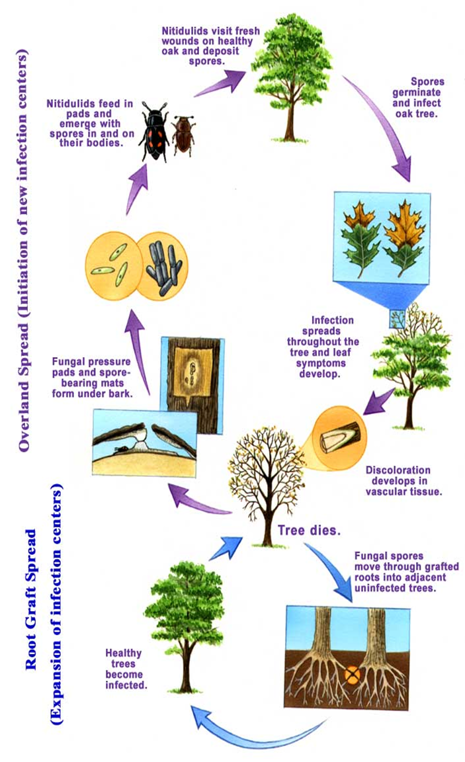
Oak Wilt Life Cycle

Root Grafts

The second way that oak wilt spreads is through the grafted (connected) root systems of individual trees. It is not at all uncommon for oak trees of the same species (i.e., red oak to red oak or northern pin oak to northern pin oak) to have a “joint” root system with an adjacent tree(s). If one tree is infected with oak wilt, the fungus can move through that tree’s root system and into the healthy tree’s root system, resulting in another infected tree.
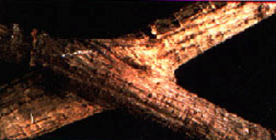
Root Grafts

Root graft transmission is the most common mode of infection. Over 90% of all new oak infections are transmitted in this manner. A root graft is formed when the roots of the same species meet and fuse together. The disease can then move from the infected tree into the uninfected tree.
Red Oaks

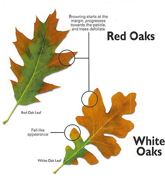
Rapid wilting of the entire canopy can indicate oak wilt in the red oak group. As previously mentioned, an infected tree of the red oak family could be entirely defoliated within just a few weeks. The wilting begins at the top of the tree and progresses downward. As the wilt progresses, the tree starts to shed its leaves. Individual leaves tend to wilt from the edges inward toward the midrib or stem of the leaf and from the tip down toward the base.

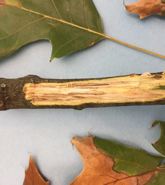
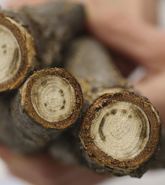
Photo cross section of White Oak branch Showing a Ring of Dots on the inside Diagrams showing what happens with leaves of trees with Oak Wilt Photo Red Oak branch showing dark colored streaking when bark is removed
White Oak showing a ring of dots, photo credit Minneapolis StarTribune Oak Wilt Symptom Red Oak Showing Dark Colored Streaking

White Oaks

Infected trees in the white oak group show similar symptoms; however, the process is much slower, frequently over several years. Another possible sign of oak wilt is discoloration or streaking of the wood just below the bark surface. However, this symptom is not always evident and should not be solely relied upon when determining whether a tree is infected with oak wilt.

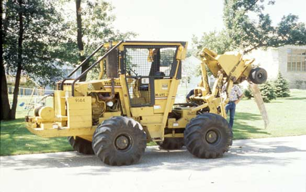
Yellow Plow

Plowing

There are several methods available for managing and/or treating oak wilt. The most effective means of managing the spread of oak wilt is through root graft disruption. This is accomplished with a vibratory plow or trenching machine that physically cuts through potentially grafted (connected) roots.

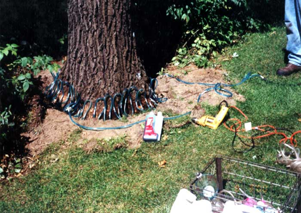
Tree Injection System

Chemical Injections

Chemical injections can also prevent new infections from occurring in red and northern pin oaks and therapeutically treat trees in the white oak family if detected early enough (generally less than thirty percent [30%] canopy wilt). Chemical treatment is accomplished by injecting propiconazole into the water-conducting vessels of a tree, as shown in the picture to the left.

Often, this treatment will be used in conjunction with root graft disruption to provide healthy trees with a better chance of survival.

Tree Removal

Tree removal is also an essential part of any management program. Potential spore-producing trees (trees that can make fungal spore mats) should be removed and properly disposed of no later than March 1 of the following year to prevent the possibility of overland spread of oak wilt. If the wood is to be used for firewood, it should be:

  • Cut and split the wood into firewood-sized pieces.
  • Cover the entire woodpile(s) with black four-mil or thicker plastic sheeting.
  • Tape all seams or breaks in the plastic with duct tape or other heavy-duty tape.
  • Bury the plastic edges around the woodpile(s) so the wood is 'sealed in.' An airtight seal is crucial to disrupt the oak wilt fungus's life cycle.
  • Keep wood covered in this manner from April 1 until October 1. After October 1, the plastic can be removed, as the wood should no longer pose a threat of spreading oak wilt.

Avoid Pruning Oak Trees

One of the most manageable and essential steps in preventing new occurrences of oak wilt is to avoid pruning oak trees from April through July. This is when the sap is flowing readily and when the insects that can transfer the disease from one tree to another are most active.


Chris Anderson
Senior Planner
Email Chris A.
763-433-9817

Oak Wilt High Risk Status

Current Oak Wilt Risk Status

In general, the risk level in Minnesota is high from April through July. During the "High Risk" period, do not wound, prune, or fell oaks. Immediately cover unavoidable wounds with a latex-based paint or shellac. 

Visit the University of Minnesota Extension webpage for more information.


Sign up to our Newsletter

Stay up to date on the city's activities, events, programs and operations by subscribing to our eNewsletters.